
India faces an increasing inflow of counterfeit currency, produced primarily in Pakistan, and terrorist and criminal networks use this money to finance their activities in the country, an official United States report has said.

Only Rs 10,720 crore of the junked currency notes did not return to the banking system, rest 99.9 per cent was deposited raising question mark over the government's effort of curbing black money through the demonetisation.

The Unlawful Activities (Prevention) Act proposes jail term of five years for any person associated with money laundering or counterfeiting in addition to the existing seven years under the Indian Penal Code. Vicky Nanjappa reports

The stage is set for the loading of cash into automated teller machines (ATMs) through the cassette-swap mode with an initial four-phased roll-out across 30 cities from June 1. The lockable cassette-swap will do away with the current practice of open-cash replenishment into ATMs. Cash-in-transit (CIT) firm personnel, tasked with loading cash into ATMs, will not have to touch it anymore. Cash-handling will be done by CITs at the cash centre, and the task of taking into account the amount of cash remaining from the last cassette-load will also be made simpler.

Fans wearing the India jersey, carrying the Indian flag, laughing, joking and anticipating an India win are moving towards the Narendra Modi stadium. There are families, friends, children, adults, teenagers, middle aged and the senior citizen who have all painted the city blue.

The Reserve Bank of India has admitted that security features introduced in the higher denomination notes in 2005 as an anti-counterfeiting measure have been breached!

The value and volume of banknotes in circulation increased by 7.8 per cent and 4.4 per cent, respectively, during 2022-23 as compared with 9.9 per cent and 5 per cent, respectively, in 2021-22, revealed the RBI annual report released on Tuesday. In value terms, the share of Rs 500 and Rs 2,000 banknotes together accounted for 87.9 per cent of the total value of banknotes in circulation as on March 31, 2023, as compared to 87.1 per cent a year ago. The Reserve Bank has announced withdrawal of Rs 2,000 notes, and holders of the highest value currency have been given time till September 30 to exchange or deposit them.

The Central Consumer Protection Authority (CCPA) on Wednesday said it has imposed a penalty of Rs 1 lakh on e-commerce firm Flipkart for allowing sale of substandard domestic pressure cookers on its platform, in violation of mandatory standards. Headed by Chief Commissioner Nidhi Khare, the CCPA has directed Flipkart to recall all such 598 pressure cookers sold on its platform, reimburse their buyers, and submit a compliance report within 45 days. The central government routinely notifies the Quality Control Orders (QCOs), specifying compulsory conformity to a standard and use of the standard mark for a product to protect consumers from the risk of suffering injury and harm and in the interest of the public at large.

The series is held together by a superbly astute performance by Gagan Dev Riar, who moves from cheerful conman to menacing criminal with remarkable skill, observes Deepa Gahlot.
There is no mechanism to ensure that the customer gets his money back and nor are there any guidelines or rules to protect the customer from this problem

Other than Snapdeal, the four markets are Tank Road in Delhi, Heera Panna in Mumbai, Kidderpore in Kolkata and Millennium Centre in Aizawl. Snapdeal, one of India's largest e-commerce platforms, is known as a place to purchase counterfeit watches and shoes.

The US on Thursday raised concerns over India's Personal Data Protection (PDP) Bill and draft non-personal data governance framework, claiming these could potentially threaten innovation and economic growth. In its latest 'Special 301' Report, the US Trade Representative (USTR) kept India on the priority watch list, maintaining the country remains one of the world's most challenging major economies with respect to protection and enforcement of intellectual property (IP). In December 2021, a joint parliamentary committee released a report recommending changes to the PDP Bill, 2019, that could undermine important IP protections in India.

Any forced attempt to achieve anything, however lofty the goal, will result in distortions and undesired outcomes, say Anshuman Gupta and Karunakar Jha.

In an online chat with readers, Investment Advisor Harsh Roongta answered their queries on the ban on Rs 500 and Rs 1000 notes.

The Jamaat-ud-Dawa not only collected funds for charity and diverted it to the Lashkar-e-Tayiba, but also helped the outfit legitimise money collected through extortion, counterfeiting, smuggling and animal skin trade. Vicky Nanjappa/Rediff.com reports

Despite the demonetisation of 2016 and the rise in digital transactions that followed, the economy's dependence on cash has remained as high as ever. So when the Reserve Bank of India (RBI) introduced a pilot project of its version of digital cash - called the central bank digital currency (CBDC) - on December 1, many questions were asked. Can the CBDC replace physical cash, even partially? Can it match cash in terms of convenience? Are CBDC transactions truly anonymous?

Priced at over Rs one-lakh, the detector machine is currently being imported from Swiss-based BEB Industrie Elektronki AG and can detect 1,200 notes per minute.
The Opposition on Thursday hit out at Prime Minister Narendra Modi saying his note ban decision was "reckless".
Counterfeiting is probably as old as money itself.
This mean that just Rs 10,720 crore of the junked currency did not return to the banking system.

In a country like India, where counterfeit items are sold in every nook and corner, the regulation of trademark infringement poses a big challenge.

Shah claimed that BJP was sensitive to the problems being faced by people queuing up outside the banks and ATMs but said they must realise that the step had hurt 'those sleeping over hoards of black money three thousand times more than the people on the streets'.

Uncertainties on account of COVID-19 pandemic have increased the demand for currency notes not only in India but across the globe, official sources said, dismissing the criticism that demonetisation has failed to reduce cash in the economy. Government sources said that growth of the digital payments system post-demonetisation will ultimately curb the dependence on cash. Official data points out a jump in digital payments through different modes, including plastic cards, net banking and Unified Payments Interface (UPI).

'Those who should have been affected benefitted from demonetisation.' 'And the vast majority who should not have been affected lost out.' 'That is the ultimate result of demonetisation.'

The quantum of fake Swiss francs remained much higher.
'Once the Hon'ble Supreme Court has declared the law, we are obliged to accept it. However, it is necessary to point out that the majority has not upheld the wisdom of the decision; nor has the majority concluded that the stated objectives were achieved,' the senior Congress leader said in a tweet.

'The execution has been 100 per cent faulty.' 'The scheme is also a stupid one, a real Tuglaq Darbar scheme.' 'This way of attacking black money is the most ineffective one.'

After a dip in 2020, the number of economic offences rose 19.4 per cent to 174,013 cases in 2021, according to the Crime in India report by the National Crime Records Bureau. The data shows that there was a marginal dip in the pendency of cases in 2021 at 96.6 per cent compared with 96.8 per cent in 2020, but this was still three percentage points higher than 93.6 per cent recorded in 2019. Economic offences include all offences of criminal breach of trust, counterfeiting, forgery, cheating, and fraud.

The draft e-commerce rules released last year held e-commerce marketplace responsible if a seller on its platform failed to deliver the goods or services ordered by a consumer "due to negligent conduct, omission or commission of any act by such seller", causing loss to the consumer.
The Financial Intelligence Unit last month marked 200 transactions in India -- running into Rs 2000 crore -- as terror-financed. Now, it has commenced its probe to trace the origin of the funds.

Widening of the tax base, doing away with cess and surcharge, improvement in compliance and moderation in tax for emerging sectors are some of the suggestions submitted to the Finance Ministry ahead of the Budget by Think Change Forum (TCF). Experts are of the opinion that there is a need to grow tax revenues for the government to drive economic growth and make investments in developmental activities, TCF, the think tank said in a statement. Towards this end, poor compliance was identified as a weak link in achieving targeted collections leading to complex issues like overtaxing, complicated tax structures, rising litigation, among others.
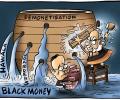
November 8 marks 6 years after demonetisation. A K Bhattacharya reveals how the prime minister and the RBI worked together for months before Modi's 8 pm speech. A riveting excerpt from The Rise Of Goliath: Twelve Disruptions That Changed India.

The ATMs will open on Friday and at many places they will open on Thursday, he said.

The RBI has shelved its plan for polymer notes more than a decade after it invited interest from global manufacturers for one billion pieces of Rs 10 denomination polymer banknotes, reveals Tamal Bandyopadhyay.

While some criticise the government, others, despite the inconvenience, hail demonetisation as revolutionary.
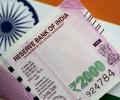
The number of Rs 2,000 currency notes in circulation has come down from 33,632 lakh pieces at end-March 2018 to 32,910 lakh pieces at end-March 2019 and further to 27,398 lakh pieces at end-March 2020.
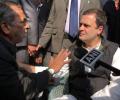
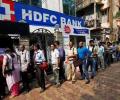
Gandhi alleged that the Bharatiya Janata Party government has "blocked" the money of the poor through currency ban to favour a "handful of industrialists".
Plastic counterfeiting and frauds have increased at an alarming rate. So how do you protect yours from being misused?

The economic affairs secretary said that the focus is on production and supply of Rs 500 and lower denomination notes.
